What Is Intent-Driven Game Development?
Defines intent-driven game development and explains how focusing on outcomes changes how games are planned and built.

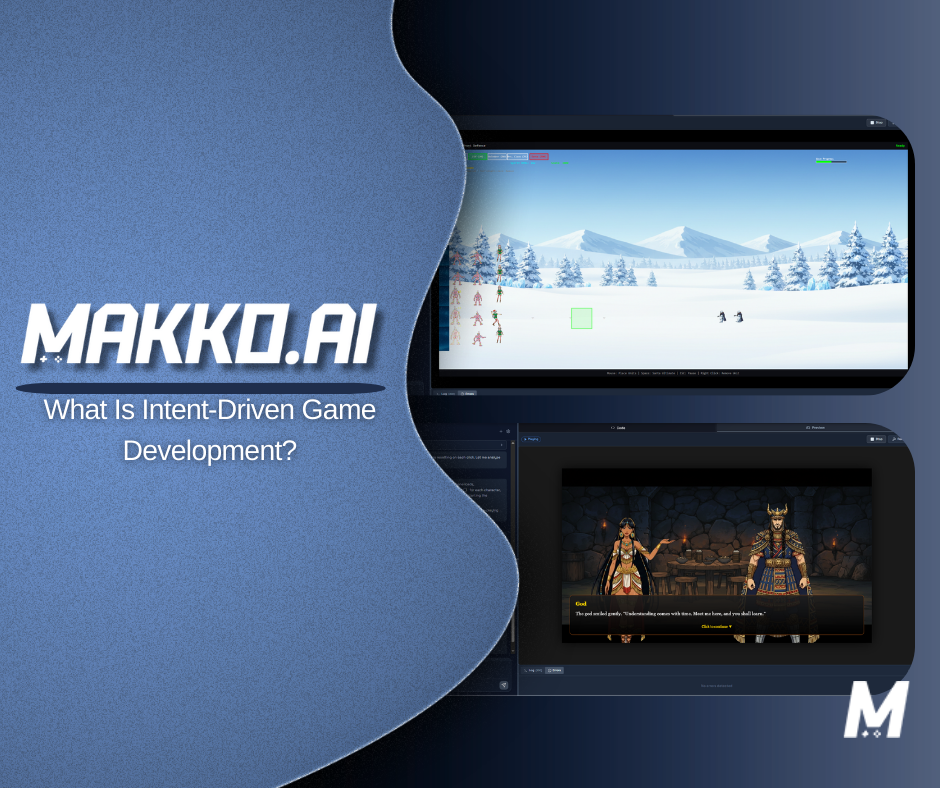
Intent-driven game development is a workflow where creators describe what a game should do in plain English rather than writing the code to make it happen. Instead of implementing systems manually, the creator specifies outcomes: what the player can do, what creates challenge, what determines success or failure. An agentic AI interprets those descriptions, plans the required systems, and assembles them into a playable result.
The shift sounds simple, but it changes the entire shape of the development process. In traditional game development, most of a developer's time is consumed by implementation work: writing code, configuring components, wiring event systems, debugging regressions. In an intent-driven workflow, that implementation layer is handled by the AI. The creator's time goes toward defining what the game should be and evaluating whether the result achieves it.
This article explains how intent-driven development works, how it differs from both traditional engines and standard no-code tools, what the actual workflow looks like in Makko, and where the approach has real limits worth understanding before you start. For definitions of terms used throughout, reference the Makko AI Game Development Glossary.
How Intent-Driven Game Development Works
Intent-driven workflows rely on agentic AI to translate high-level descriptions into structured game systems. The creator communicates using natural language game development: describing desired behaviors, rules, and outcomes in plain English rather than technical instructions.
When a description is submitted, the agentic system does not immediately generate output. It reads the current project state first: what systems already exist, what state variables are in use, how the new request relates to what has been built. Only after that check does it plan the sequence of implementation steps required. Only after planning does it begin building. This planning layer is what separates intent-driven development from a chatbot that generates code snippets: the agent acts as a technical lead that understands the whole project, not just the current prompt.
The practical result is that new additions integrate cleanly into the project rather than being appended to it. A scoring system added in session three is aware of the health system and enemy behavior established in session one. A new enemy type introduced in session five understands the difficulty progression that was defined in session two. The game grows coherently rather than accumulating disconnected generated components that require manual integration.
Intent vs. Implementation: The Core Distinction
The distinction between intent and implementation is the most important concept in understanding why this approach is different from what came before it.
In a traditional game engine, you work at the implementation level. When a player collides with an enemy, you decide what collision means, write the detection logic, define the state change, and connect it to the health system. If you want the enemy to slow down as the player progresses, you write the scaling logic, identify where in the update loop it belongs, and test that it does not produce unexpected behavior in edge cases. Every mechanic is an implementation task before it is a design decision.
In an intent-driven workflow, you describe the outcome. "Contact with an enemy reduces player health by one. When health reaches zero, the game ends." "Enemies move 10% faster after each completed level." The agentic system identifies what systems are required to produce those outcomes, determines how they interact with the existing project, and builds them in the correct order. You did not write collision detection, state management, or a difficulty scaling function. You described what you wanted and the agent handled the how.
This is not a shortcut that removes design thinking. It changes how design decisions are expressed. In a traditional workflow, a design decision becomes an implementation task before it can be tested. In an intent-driven workflow, a design decision becomes a prompt that produces a testable result immediately. The feedback loop between "I want to try this" and "I can see whether this works" compresses from hours or days to minutes.
How This Differs From No-Code Tools
Intent-driven development is often grouped with no-code game development, but the two are meaningfully different and the distinction matters when choosing the right tool for a project.
No-code tools, including visual scripting systems and template-based builders, let you configure from a fixed menu of pre-built behaviors. They are accessible and often produce reliable results for the use cases they were designed for. Their limit is that the creative constraint is the template library: if the behavior you want is not in the menu, you cannot build it without writing extensions or switching to a traditional engine.
Intent-driven development generates custom logic from your description rather than assembling from pre-built components. The creative constraint shifts from what the tool has pre-built to what you can clearly articulate. Unconventional mechanics, genre hybrids, and custom behaviors that would require workarounds or extensions in a no-code tool are approached the same way as any other request: you describe the outcome and the agent builds it.
The failure mode is also different. When a no-code platform cannot support a mechanic, you have hit a hard ceiling. When an intent-driven system produces something that does not match your intent, you describe the correction and the agent revises. The iteration loop stays open. The wall does not exist in the same way.
The Full Workflow in Makko
In Makko, intent-driven game development runs across two connected environments. Art Studio handles everything visual. Code Studio handles game logic. Both operate on the same intent-driven principle: you describe what you want and the AI builds it.
In Art Studio, the workflow begins with concept art inside a Collection. You describe the game world and generate concept art that establishes the visual direction. Collections give the AI persistent context about the game's visual world so that every character, background, and prop generated inside the Collection references the same visual foundation. This is the structural mechanism that keeps art consistent across an entire project without requiring detailed style descriptions in every generation prompt.
Characters are generated with the Character Sprite preset, which automatically produces a transparent background in a sprite-ready format. After saving a character, Makko prompts you to generate a Reference Sheet: three views of the character from front, side, and back. This is required before animation. The AI needs the multi-angle view to generate consistent animation frames. Backgrounds and props follow the same workflow in sub-collections, each inheriting the visual context of the parent Collection automatically.
In Code Studio, you open AI Chat and describe the game loop: the player goal, the source of tension, the win and loss conditions. The agentic system reads the current project state, plans the required systems, and implements them. You play the result in the Preview Tab and describe what needs to change. Quick Actions at the top of the interface handle the most common tasks: Add a Character places a character manifest from your Art Studio library into the scene; Assign an Action maps character animations to player input controls; Add a Background pulls from your asset library and sets display options.
For complex additions, Plan Mode surfaces the agent's full plan before execution. You review what it intends to build, which existing systems it will modify, and what the expected result is. You can push back, ask for alternatives, and approve before anything is written. Fast Mode handles targeted, well-scoped changes immediately without the planning review. The practical rule is the same throughout: if the change could affect something that already works, Plan Mode. If the scope is clear and isolated, Fast Mode.
What Effective Intent-Driven Prompts Look Like
The quality of results in intent-driven development scales directly with the clarity of the descriptions. Vague prompts produce vague results. Outcome-focused prompts that describe what the game should do and feel like produce results that are much closer to the intent on the first build.
Effective intent prompts describe three things: what happens, when it happens, and what the result is. They do not instruct the AI on how to implement anything.
None of these prompts mention variables, event listeners, state machines, or any implementation detail. Each one describes a desired outcome clearly enough for the agentic system to plan and build the required systems. This is the core skill in intent-driven development: not programming, but the ability to describe what you want precisely and evaluate whether the result matches your intent.
Who Benefits From This Approach
Intent-driven game development opens the creation process to a much wider range of people than traditional development allows. The shared benefit across all of them is faster movement from idea to playable experience.
For beginners with no coding background, it removes the barrier that has historically separated wanting to make a game from actually building one. The learning curve is not a scripting language or engine architecture. It is the ability to describe what you want clearly. That skill develops quickly in practice.
For designers and artists who understand what makes a game feel good but not how to implement it, intent-driven development lets them work directly in the medium of the game rather than through a technical intermediary. The design work and the building work happen in the same conversation.
For experienced developers, the value is in prototyping speed. Testing whether a core loop is fun before committing engineering resources to it is one of the most valuable activities in game development. Intent-driven creation compresses that test from weeks to a single session. Many developers use Makko to validate a concept before moving to Unity or Godot for full production once the design is proven. For real examples of games built this way, see what creators have shipped without writing code. For a direct comparison of this approach against manual scripting, see C# vs intent.
For educators teaching game design, it removes the implementation barrier entirely and lets students focus on design decisions: what makes a mechanic satisfying, how difficulty curves work, why some loops are compelling and others are not. The concepts can be tested immediately rather than deferred until students have learned to code.
Where the Limits Are
Intent-driven game development is not a universal solution and being honest about its limits is more useful than obscuring them.
It is well-suited for 2D games of any genre, visual novels, browser-playable experiences, and any project where the goal is to validate a concept quickly or build a complete game without engineering resources. Within that scope it is capable and efficient.
It is not designed for large-scale open-world 3D games, custom physics engines, complex multiplayer networking, or production pipelines that require deep engine-level customization. These projects need traditional engines and engineering teams. The two approaches serve different stages and different project types. Many creators use intent-driven development for prototyping and validation, then move to a traditional engine for full production once the core design is confirmed.
Within its scope, the quality of results scales with the clarity of descriptions. Building incrementally and using Plan Mode for complex changes prevents most stability issues. The agentic system checks project state before every action, but giving it clear, outcome-focused descriptions makes that check more effective and reduces the likelihood of misaligned results.
Frequently Asked Questions
What is intent-driven game development?
Intent-driven game development is a workflow where creators describe what a game should do in plain English rather than writing the code to make it happen. Instead of implementing systems manually, the creator specifies outcomes: what the player can do, what creates challenge, what determines success or failure. An agentic AI interprets those descriptions, plans the required systems, and assembles them into a playable result. For a full breakdown of how this works, see what is intent-driven game development.
How is intent-driven game development different from traditional game development?
Traditional game development requires working at the implementation level: writing code, configuring components, wiring event systems, and debugging regressions manually. Intent-driven development shifts that responsibility to the AI. The creator defines goals and describes outcomes. The agentic system determines how to implement them, maintains awareness of the full project state, and checks new additions against existing systems before building.
Do you need coding experience for intent-driven game development?
No. The purpose of intent-driven development is specifically to remove that requirement. You describe what you want the game to do and the AI handles the implementation. The skill that develops is not programming but the ability to describe experiences clearly and evaluate whether the result matches your intent. For a full step-by-step walkthrough, see the complete guide to making a game without coding.
What is the difference between intent-driven development and no-code tools?
No-code tools let you configure from a fixed menu of pre-built behaviors. If the behavior you want is not in the template library, you are stuck. Intent-driven development generates custom logic from your description. The creative constraint shifts from what the tool has pre-built to what you can clearly articulate. Unconventional mechanics, genre hybrids, and custom behaviors are all possible without hitting a template ceiling.
What types of games can be built with intent-driven game development?
Intent-driven development works best for 2D games of any genre: platformers, roguelikes, top-down games, visual novels, puzzle games, survival games, and browser-playable experiences. It is optimized for rapid prototyping and early-stage development. It is not designed for large-scale 3D games, custom physics engines, or production pipelines requiring deep engine customization.
For detailed walkthroughs and live feature demos, visit the Makko YouTube channel.