Can You Build Game Logic Without Coding?
Explores how game logic can be built without coding by using AI-driven planning, state management, and system orchestration.

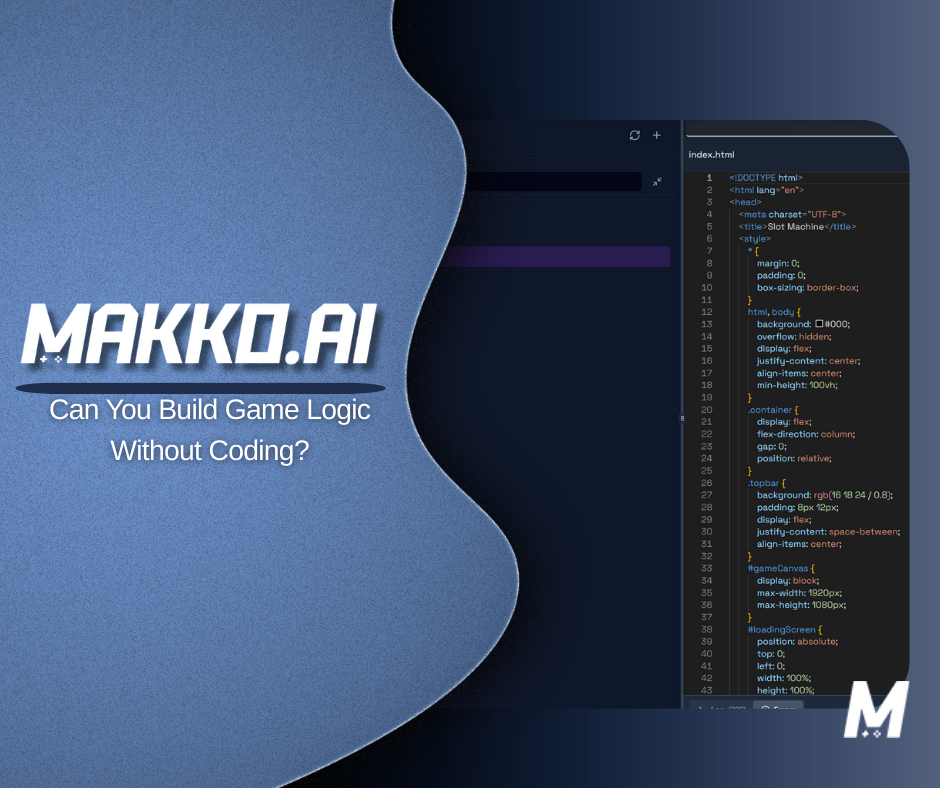
Yes. You can build game logic without writing a single line of code. The more useful question is how it actually works, what the AI is doing when you describe a mechanic in plain English, and where the approach has real limits.
The methodology is called intent-driven game development. Instead of writing code to implement a mechanic, you describe what you want the mechanic to do. An agentic AI interprets the description, breaks it into implementable tasks, builds the required systems, and maintains awareness of the full project so new additions do not break what was already working. For a direct comparison of this approach against manual scripting, see C# vs intent.
This is not the same as dragging nodes around in a visual scripting tool or picking from a menu of pre-built behaviors. Intent-driven development generates custom logic from your description. The constraint is not what the tool has pre-built. The constraint is what you can clearly articulate. This approach is closely related to vibe coding, building by describing the experience you want rather than writing the implementation.
This article explains the underlying mechanism, how it differs from traditional no-code approaches, and how to use it effectively in practice.
What Intent-Driven Game Development Actually Means
In a traditional engine, building game logic means writing code. Every event needs a handler. Every variable needs to be declared and managed. Every relationship between systems needs to be explicitly wired. This is precise work that requires deep familiarity with the engine's architecture, and it is the primary reason most game ideas never become playable prototypes. The time between "I want to make a game" and "I have something I can play" is dominated by technical setup, not creative decisions.
Intent-driven game development inverts this. You describe the outcome. The AI handles the implementation. You say "the player loses health when they touch an enemy, and the game ends when health reaches zero." The AI identifies the variables required, builds the collision detection trigger, wires the health decrement, checks the loss condition, and connects it to a game-over state. You did not write any of that. You described what you wanted and the system assembled it.
The key word in that description is "assembles." The AI is not guessing at what code might work. It is planning a sequence of implementable tasks based on your description, checking how those tasks interact with what already exists in the project, and building them in the correct order. This is what separates agentic AI from a one-shot code generator: the planning layer and the state awareness that comes with it.
How Task Decomposition Works in Practice
Task decomposition is the process by which an agentic AI breaks a high-level description into a sequence of dependent implementation steps. It is the mechanism that makes intent-driven development work for anything beyond trivial mechanics.
Consider the prompt: "Add a shop where the player can spend coins to buy speed upgrades." A one-shot AI tool might generate a code snippet for a shop function. That snippet would not know about your existing coin system, your player movement variables, or how your UI is structured. You would need to manually integrate it into the rest of the project.
An agentic system handles this differently. Before writing anything, it reads the current project state. It finds the coin variable, checks how it is currently tracked and updated, looks at the player movement system to understand what a speed upgrade would need to modify, reviews the existing UI structure to determine where the shop interface should live, and then plans the full sequence of changes required. Only after that planning step does it begin building. The result is a shop that actually works within your game rather than a generic shop template that needs manual wiring.
This is why the prompt you give matters less than the clarity of the outcome you describe. The agent can handle ambiguity in the implementation. It cannot handle ambiguity in what you actually want. "Add a shop" is harder to act on than "Add a shop where the player can spend coins on three upgrade types: speed, jump height, and damage." The more specific the outcome, the more precisely the agent can plan.
| Vague prompt | Outcome-focused prompt |
|---|---|
| Add a shop | Add a shop where the player spends coins on speed, jump, and damage upgrades. Show it when the player presses E. |
| Make enemies harder | Increase enemy movement speed by 10% every 30 seconds. Cap the increase at double the starting speed. |
| Add a score system | Add a score counter that increments by 10 each time the player collects a gem. Display it in the top right corner and save the high score between sessions. |
Game State: The Problem That Breaks Most No-Code Approaches
Game state is the collection of variables that define the current condition of a game at any given moment: player health, score, enemy positions, inventory contents, which level the player is on, which objectives have been completed. Every mechanic in a game reads from or writes to game state. When state is managed inconsistently, the game breaks in ways that are difficult to trace.
This is the central technical challenge in no-code game development, and it is the reason most no-code approaches have a hard ceiling. Visual scripting tools and template-based builders manage state within their own predefined structures. As long as your game fits those structures, state management is handled for you. The moment you need behavior outside the template, you are managing state manually, which requires understanding the architecture well enough to do it correctly.
Intent-driven development addresses this through what the playbook calls state awareness: the agentic AI maintains a running model of the full project state and consults it before every action. When you add a new mechanic, the agent checks how the new code will interact with existing state variables before writing anything. Conflicts are caught at the planning stage rather than discovered during testing.
This is why building iteratively works better than trying to describe the full game in a single prompt. Each addition is checked against the current state of the project. The agent knows what is already there. Adding a checkpoint system when the game already has a health system and an enemy spawner produces a result that correctly interacts with both, because the agent read both systems before building the checkpoint logic.
Natural Language vs. Visual Scripting: How They Differ
Visual scripting and natural language development both let you build game logic without writing syntax. They solve the problem differently and are suited to different situations.
Visual scripting uses a node-based interface where you connect predefined actions and conditions graphically. It is precise and inspectable: you can see exactly what each node does and trace the flow of logic visually. It is excellent for well-understood mechanics with straightforward if-then relationships. Its limit is that it requires the behavior you want to already exist as a node in the system. If you need something the tool has not pre-built, you are stuck.
No-code game development through natural language works differently. You describe the behavior in plain English and the agent generates the logic required to produce it. The behavior does not need to exist as a pre-built template. If you can describe it, the agent can build it. The tradeoff is that the generated logic is not visually inspectable in the same way. You evaluate it by playing the game and describing corrections.
The practical distinction comes down to novelty. For standard mechanics in well-understood genres, visual scripting is reliable and precise. For custom mechanics, genre hybrids, or anything outside the template library, natural language development is the faster path. Many creators use both: natural language to establish the core systems quickly, and more targeted iteration to polish the behavior of specific mechanics once the structure is in place.
Practical Logic Prompts That Work
The following prompts illustrate how intent-driven game development works across common logic scenarios. Each is written as an outcome description rather than a technical instruction.
Win and loss conditions:
Enemy behavior:
Progression and scaling:
Economy and resources:
These prompts share a common structure: they describe what happens, when it happens, and what the result is. They do not instruct the AI on how to implement the logic. The agent handles the how. The creator handles the what.
AI as Accelerator, Not Replacement
Intent-driven game development is best understood as a workflow accelerator rather than a replacement for all forms of programming. The distinction matters for setting realistic expectations about what the approach can and cannot do.
For prototyping, validating a core loop, and building browser-playable games from scratch, agentic AI handles the logic reliably enough to produce stable, playable results across a wide range of game types. The workflow removes the boilerplate barrier that historically consumed the early phases of development and lets creators test whether an idea is actually fun before investing significant time in it.
For production-scale games that require custom rendering pipelines, multiplayer networking, platform-specific performance optimization, or deep engine-level customization, a traditional engine with engineering resources is the right tool. Intent-driven development is not designed to replace that work. It is designed to handle the phase that comes before it: moving from idea to playable quickly enough that the right ideas get identified and built out.
Many creators use Makko to prototype and validate the core loop, then move to Unity or Godot for full production once the game concept is proven. This is a sensible workflow. The two approaches are not in competition. They serve different stages of a project. For real examples of games built entirely without coding, see what creators have shipped using this workflow.
For solo creators and small teams without dedicated engineering resources, the Makko workflow often serves the full pipeline. The browser-playable result is the goal, and the intent-driven approach gets there without requiring the technical overhead that has historically made that goal inaccessible to most people who have a game idea worth building.
Using Plan Mode for Complex Logic
Not every logic addition carries the same risk. Adding a sound effect when the player jumps is a contained, low-risk change. Redesigning the enemy behavior system to add multiple behavior states is an architectural change that touches multiple parts of the project. Treating these the same way leads to preventable instability.
Makko's Code Studio addresses this with Plan Mode. For complex or architectural changes, Plan Mode activates deeper reasoning before execution. The agent maps the full scope of the change, surfaces which existing systems will be affected, and presents the plan for your review before writing any code. You can push back on any part of the plan, ask for alternatives, or approve and proceed. Nothing is built until you confirm.
Fast Mode handles routine changes: adjusting a value, adding a UI label, tweaking a spawn rate. It skips the planning layer and executes immediately, which is appropriate when the scope is clear and the risk of side effects is low.
The practical rule is the same one used throughout this article: if the change could affect something that already works, use Plan Mode. If the scope is isolated and well-defined, Fast Mode is faster. Developing an intuition for that distinction is one of the most valuable skills in an intent-driven development workflow.
Frequently Asked Questions
Can you build game logic without coding?
Yes. In an AI-native studio like Makko, you describe the behavior you want in plain English and the agentic AI plans and implements the underlying logic. You define outcomes: what the player does, what creates challenge, what defines success or failure. The AI handles the code, the system dependencies, and the state management. For a full walkthrough of this in practice, see the complete guide to making a game without coding.
What is intent-driven game development?
Intent-driven game development is a methodology where creators describe what they want a game to do rather than writing the code to make it happen. An agentic AI interprets the description, decomposes it into a sequence of implementable tasks, builds the required systems, and maintains awareness of the full project state so new additions do not conflict with what was already built.
How does agentic AI handle task decomposition in game development?
When you describe a mechanic in plain English, the agentic AI breaks it into a sequence of dependent tasks before implementing any of them. For example, describing a shop system triggers the agent to identify the required currency variables, inventory state, UI elements, and event triggers, then build and connect them in the correct order. Dependencies are managed automatically.
What is game state and why does it matter for no-code development?
Game state is the collection of variables that define the current condition of a game at any given moment: player health, score, enemy positions, inventory contents, current level. Maintaining consistent game state across multiple sessions of AI-assisted building is the primary technical challenge in no-code development. Agentic AI solves this by tracking the full state model before every action, so new additions do not produce inconsistencies in the existing logic.
Is natural language game logic as reliable as hand-written code?
For prototyping, validating ideas, and building browser-playable games, agentic AI-generated logic is reliable enough to produce stable, playable results. It is not designed to replace hand-written code for production-scale games that require custom rendering, multiplayer networking, or platform-specific optimization. The right frame is to treat it as a tool for moving from idea to playable quickly, with the option to move to a traditional engine for full production once the core loop is validated.
For detailed walkthroughs and live feature demos, visit the Makko YouTube channel.