No-Code Roguelike: How I Shipped a Full AI-Generated Game in 10 Days (Devlog #1)
TL;DR: I prototyped the core gameplay loop for a roguelike in 10 days using Makko.ai for every line of code, every asset, and every design decision. This is the first devlog: the premise, the pipeline, and why AI game development is letting me ship a new roguelike set in a post-apocalyptic corporate dystopia without a team or a budget.
The Pitch (and the Fine Print)
You wake up to a notification, not an angel.
"Good morning, valued asset! Cryosleep complete. Debt initialized."
Last thing you remember, you were a reasonably successful software engineer on Old Earth. You bought the deluxe "Wake Me When It's Better" cryo package: skip the apocalypse, skip the job market collapse, fast-forward to the part where society needs your skills again. Turns out the fine print had other ideas.
Over the centuries your "premium retirement contract" got bundled, sliced, and traded as debt. Eventually someone realized it was cheaper to wake the collateral, slap a 1,000,000 credit "reanimation and administrative" debt on each thawed engineer, and ship you into deep space than to build more robots. Robots are expensive. You were already paid for.
So here you are: stuffed in a discount orbital tin can, pointed at unstable sectors full of hostile anomalies and highly valuable materials. Your job: dive, scavenge, not die, and work off a mountain of compounded centuries-old "service fees" by bringing home loot for people who have never heard of JavaScript but still somehow own your life.
The twist? With no surviving family (they have been dead for centuries) the generous "death in the line of corporate duty" benefits get routed right back to the corporation. So you are the perfect asset: too obsolete to threaten the executive AI, too indebted to say no, and worth more dead than frozen.
Welcome to Sector Scavengers. Fire up the systems, check your hull integrity, and try not to think too hard about the fact that your most valuable skill now is being cheaper than a robot.
Why AI Game Development Makes This Possible
I am writing this for three audiences: people curious about AI game development and art pipelines, players hunting for new roguelike games, and anyone who loves post-apocalyptic corporate dystopian stories. Sector Scavengers sits at the intersection of all three.
I have no art team, no dedicated designer, and no 12-month production cycle. What I have is Makko.ai.
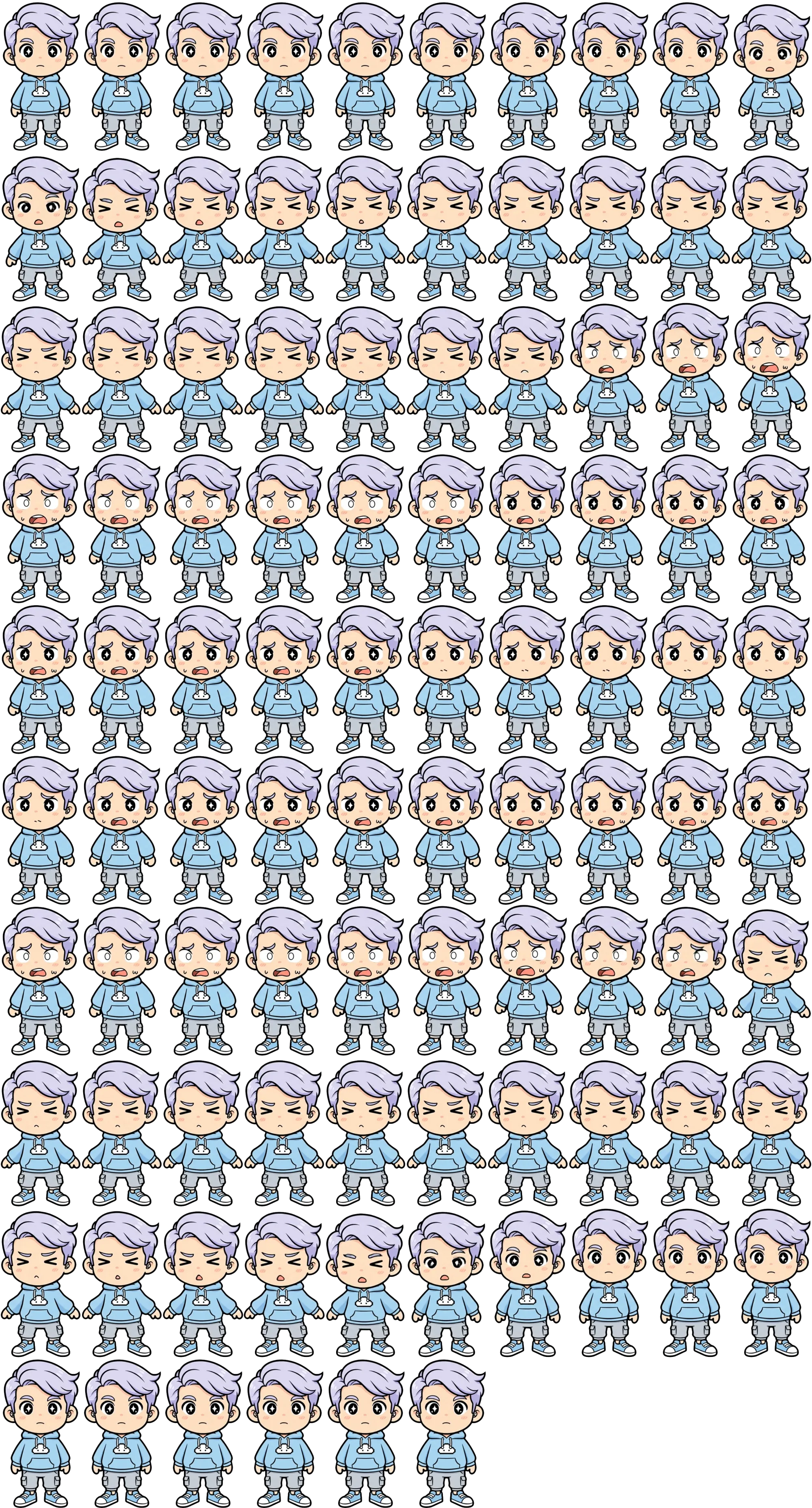
Every asset in the game came through Makko's Art Studio: character sprites, tactic card illustrations, ship sprite sheets, backgrounds, and animations. The pipeline is straightforward: describe what you need, generate, extract frames, integrate. No Photoshop, no hand-drawn frames, no outsourcing. For a solo developer doing indie game development without a team, that is the difference between "maybe I will add art later" and "here is a full set of tactic cards and a playable loop on day 10."
The pipeline that makes this repeatable: describe, generate, extract, integrate. No style drift between assets, no back-and-forth with contractors, no waiting. Below is what that looks like in practice across every asset category in the game so far, all built through Makko's AI game art generator.
From Art Studio to Game: What 100% AI Actually Looks Like
Ships and Sprites
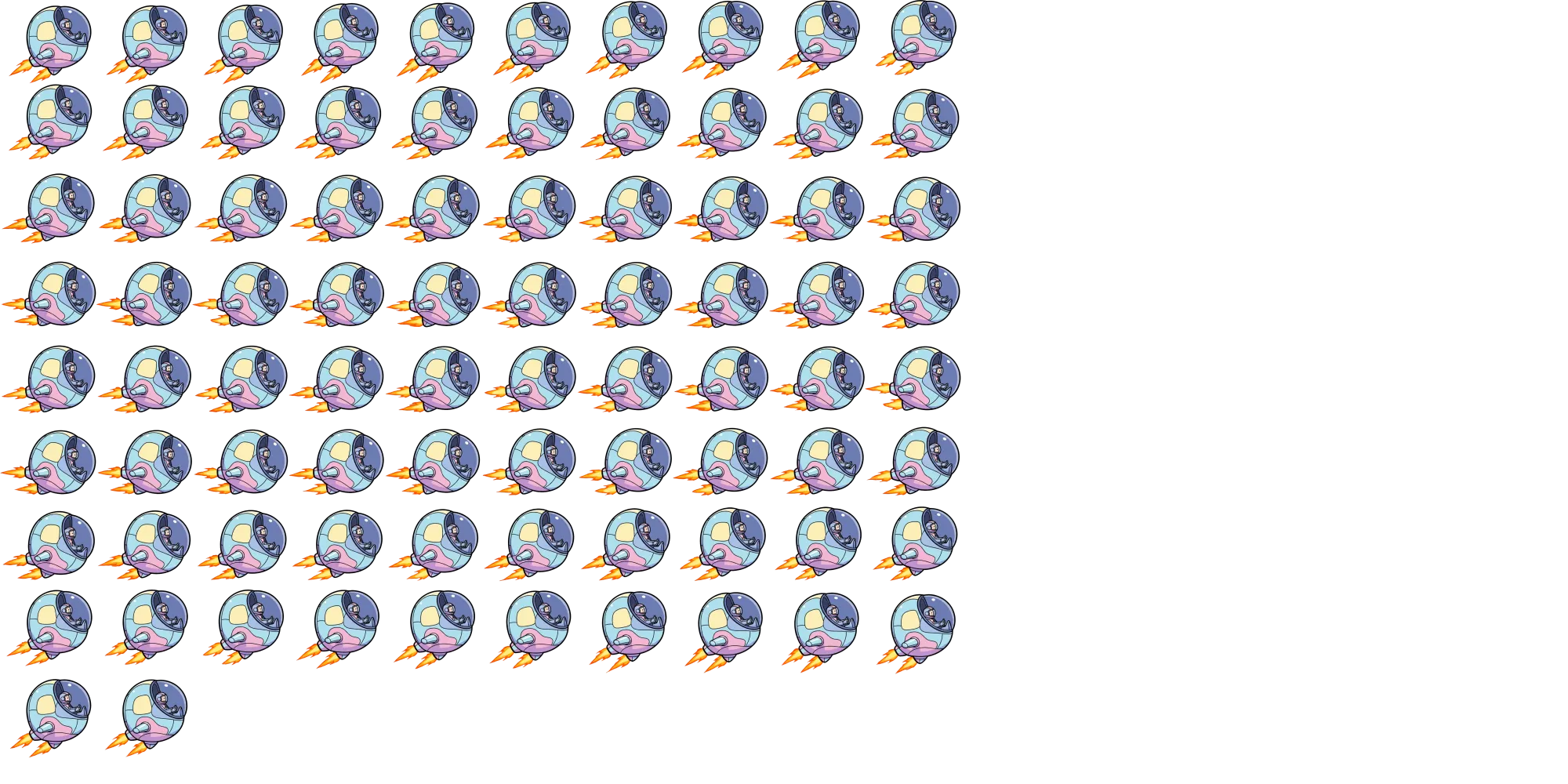
The player's ship, that "discount orbital tin can," started in Makko as a concept prompt. Art Studio let me define an idle animation (floating, 12 FPS), preview the source video, and extract frames for a sprite sheet. That utilitarian, slightly beat-up look is intentional. This is not a hero ship. It is the thing the corporation gave you because it is cheaper than writing you off.
The same pipeline produced the freighter sprite sheet visible in-game: multiple frames for thrusters and movement so the ship feels alive instead of static. This is the sprite animation workflow in its most direct form: describe, generate, extract, integrate.
Tactic Cards: Risk, Repair, Extract, Survive
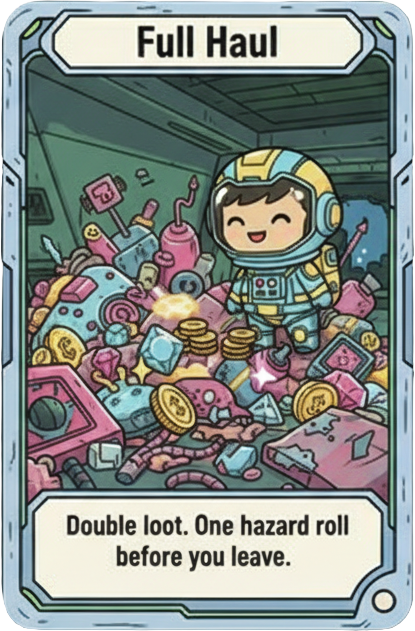
Roguelike runs live or die on meaningful choices. In Sector Scavengers, tactic cards are those choices. Each card needed a clear mechanical identity and a visual that matched the tone: worn, corporate, slightly cute but grim. This is exactly the kind of asset work that would typically require an artist and multiple revision rounds. With Makko's AI art pipeline, the entire set came together in a single session.
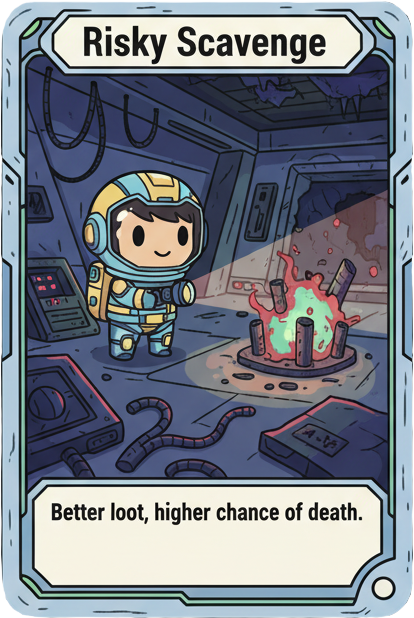
Risky Scavenge: Better loot, higher chance of death.
Art: Scavenger in a derelict interior, flashlight on a hazardous anomaly. One image to sell the risk/reward.
Repair: Fix hull damage or restore systems.
Art: Robotic arm welding a battered hull, big yellow wrench. Survival in a can.
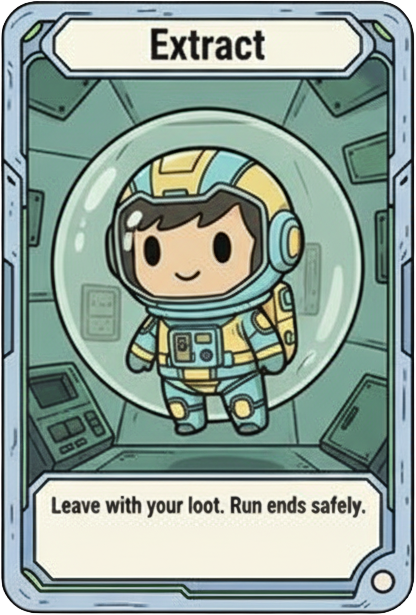
Extract: Leave with your loot. Run ends safely.
Art: Scavenger in a protective bubble inside a cramped ship. The only way to "win" a run.
Patch and Hold: Emergency hull stabilization: prevents damage once.
Art: Jagged hole in the hull, transparent patch, orange clamps. One last chance before the void.
All of these were generated and iterated through the same AI art pipeline. Consistent line work, consistent color language, no style drift, and no multi-week back-and-forth with an artist. For a first devlog, this is the proof of concept: AI game development is not "slap a prompt on it." It is a repeatable pipeline: describe, generate, extract, integrate. A full set of card art and character sprites in days instead of months.
Atmospherics: Backgrounds and Tone
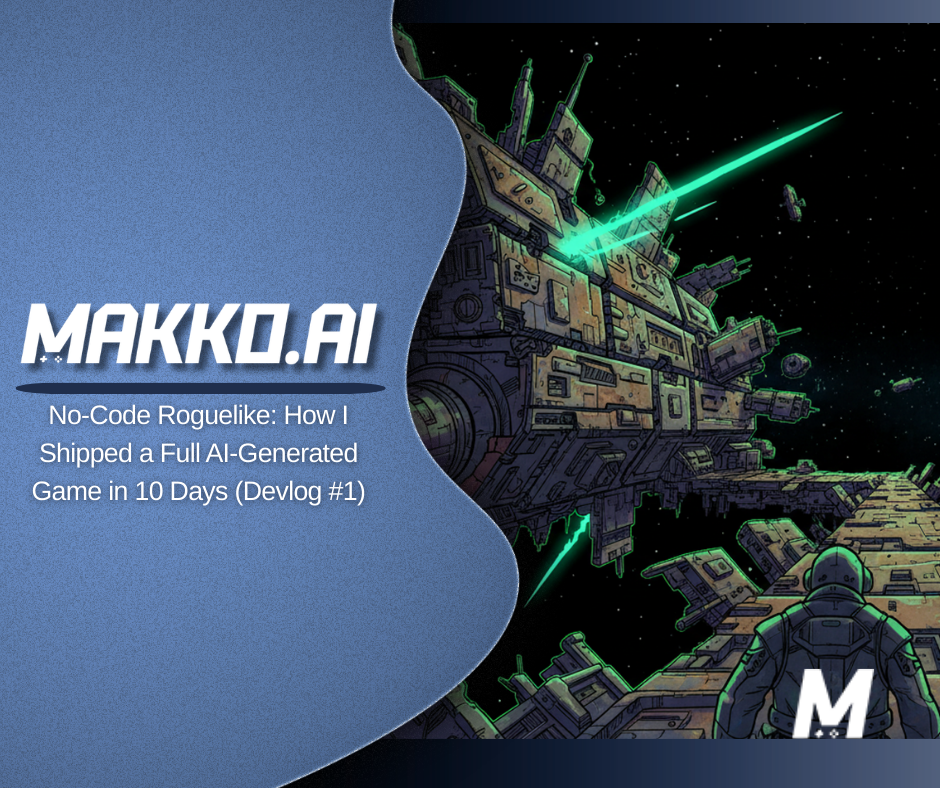
The game's backgrounds set the mood: deep space, derelict structures, purple and green energy, debris. One key art piece shows the scale of the world: a lone astronaut on a walkway, facing a colossal, battered freighter, neon green and purple cutting through the dark. That contrast, one small figure against one massive, indifferent machine, is the post-apocalyptic corporate dystopia in a single frame.
The game uses parallax scrolling backgrounds to give the player the feeling of navigating through a field of debris and derelict spacecraft. These are not static images: each layer moves independently at different depths, making the environment feel alive even during low-action moments between card choices.
New Roguelike, Same Debt
Sector Scavengers is a roguelike at the mechanical level: you do runs, you make card-based choices, you manage risk: scavenge vs repair vs extract, and you either leave with loot or you do not. Death advances progression in twisted, corporate-friendly ways.
The twist is the setting: you are not a chosen one. You are collateral. The game loop, try, die, unlock, try again, is mapped onto a story where "try again" means the next thawed body gets the benefit of your last run's failure. Death is not just a mechanic. It is the business model.
If you are looking for new roguelike games that are not just another fantasy dungeon or space shooter, this is that: card-driven, atmosphere-heavy, and built to make "one more run" feel like both a gameplay hook and a dystopian punchline.
What's Next
Ten days got me: a playable depth-dive loop, a full set of tactic cards with AI-generated art, character and ship sprites, backgrounds, and a premise I can keep mining for tone and mechanics. Every visual asset came out of Makko's Art Studio using consistent game art across every asset. For real examples of what this kind of full pipeline produces, see what other creators have shipped.
The next devlogs will go deeper into death unlocks, inventory and item wayfinding, and making repair and shields feel as high-stakes as the fiction. For the UI and Command Deck design side of the same game, see the Sector Scavengers command deck devlog. For how that same pipeline handled 100 card art assets in 7 days, see the 100 game cards devlog.
If you are into AI game development, roguelikes, or post-apocalyptic corporate dystopian stories: this is the first of many updates. Thanks for reading. And if you are a valued asset somewhere, maybe do not read the fine print.
Frequently Asked Questions
What is Sector Scavengers?
Sector Scavengers is a card-based roguelike set in a post-apocalyptic corporate dystopia. Players take the role of a debt-laden scavenger diving into unstable sectors to collect loot. Each run involves card-based choices between scavenging, repairing, or extracting. Death advances progression in ways that fit the setting: the next thawed body benefits from the previous run's failure. The game was prototyped in 10 days using Makko AI for all code, art, and design.
How was Sector Scavengers built using AI game development tools?
Every asset came through Makko's Art Studio: character sprites, tactic card illustrations, ship sprite sheets, backgrounds, and animations. The pipeline is describe, generate, extract, integrate. No external art tools, no contractors, no style drift between assets. Game logic was built through Makko's Code Studio using plain language descriptions rather than manual scripting.
What kind of roguelike is Sector Scavengers?
Sector Scavengers is card-driven with run-based progression and risk management mechanics. Players choose between tactic cards each turn: Risky Scavenge for better loot at higher risk, Repair for hull and system recovery, Extract to end the run safely with current loot, and Patch and Hold for emergency hull stabilization. The setting is a post-apocalyptic corporate dystopia where death is part of the business model.
Can a solo developer build a full roguelike using AI tools?
Yes. Sector Scavengers was built by a solo developer with no art team, no dedicated designer, and no extended production timeline. Using Makko AI for all assets and code, a playable core loop with full card art, character and ship sprites, and parallax backgrounds was completed in 10 days. The AI game development pipeline replaces the traditional bottlenecks of asset creation and manual scripting that typically require a team.
For more devlogs, tutorials, and live builds, visit the Makko YouTube channel.
Related Reading
- How to Make a Game Without Coding
- Makko Art Studio Props Generator: A Pipeline Efficiency Guide
- How to Add Animated Characters to a Game Using Makko
- AI Character Creator vs Sprite Sheets: What's Actually Happening
- What Is Agentic AI in Game Development?
- C# vs Intent: Why Manual Scripting Stalls Indie Progress