State-Awareness vs. One-Shot Prompts: Why Your AI Game Logic Keeps Breaking
Explains why AI game logic breaks without persistent state and how state-aware workflows enable stable, iterative game development.

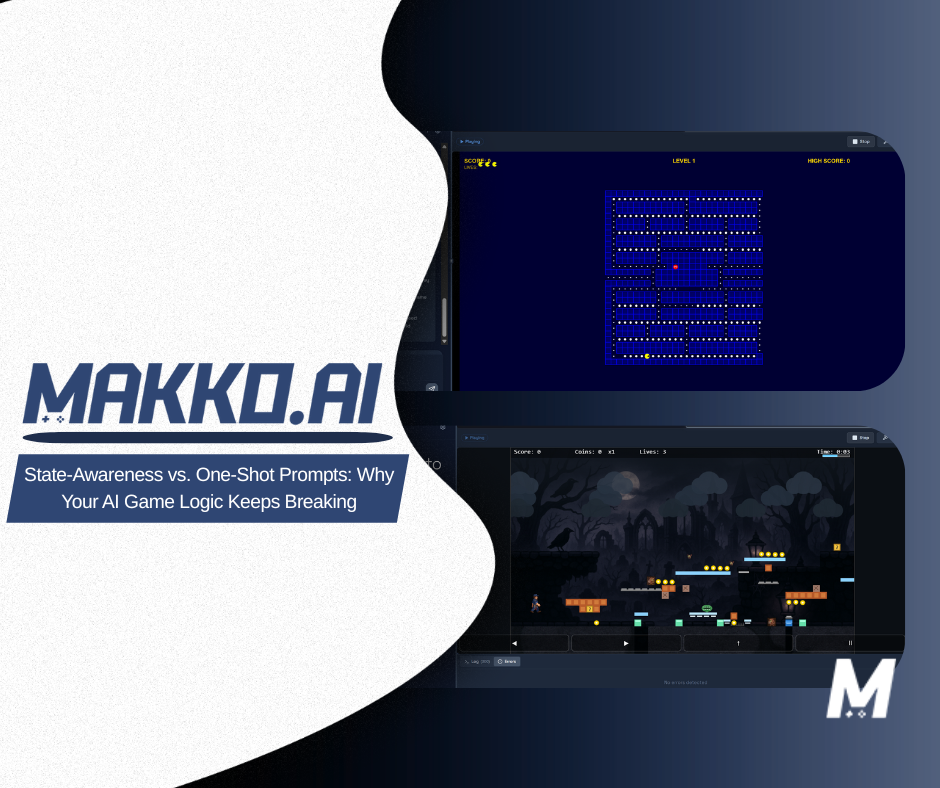
Most failed AI-built games do not break because the underlying models are weak. They break because the system has no state awareness. Creators rely on one-shot prompts to generate logic, then discover that progression resets, variables drift, or mechanics contradict each other after a few iterations. This failure mode is structural, not creative. Without persistent game state, AI systems cannot reason about continuity, causality, or system dependencies.
AI game development studios designed around persistent project context solve this by maintaining awareness of everything that has been built across every iteration: the difference between a fragile demo and a game that holds together under real gameplay conditions.
Why One-Shot Prompts Fail at Game Logic
One-shot prompting treats game development as a sequence of isolated text generations. Each request, "add enemies," "increase difficulty," "add an inventory system," is executed without a durable memory of prior decisions. The result is state drift: variables are redefined, systems overwrite each other, and edge cases compound with every iteration.
In game logic, state is not optional. Win conditions, cooldowns, progression flags, and difficulty curves all depend on shared context. A stateless AI model cannot reliably answer questions like:
- Has the player already completed this objective?
- Which state variables should persist between scenes?
- How does this new mechanic affect the existing game loop?
Traditional engines solve this with explicit architecture: developers manually define data models, state machines, and dependency graphs. Most one-shot AI tools skip this layer entirely, producing impressive outputs that collapse under real gameplay conditions because nothing is tracking the relationships between what was built.
What State-Aware AI Actually Changes
State-aware systems treat a game as a living project rather than a collection of text outputs. Instead of responding to isolated prompts, the AI maintains an internal representation of:
- Active systems and mechanics
- Declared rules and constraints
- Persistent variables and progression flags
- Relationships between scenes, characters, and events
In an agentic AI workflow, changes are evaluated against the existing project state before execution. This allows the reasoning engine to perform task decomposition without invalidating prior logic: identifying what needs to change, what needs to be created, and what must remain untouched in the correct order.
The practical consequence is that changes to a project stop accumulating risk as the project grows. In a one-shot workflow, each new addition is a liability: it might conflict with something that came before it. In a state-aware workflow, each new addition is evaluated against what already exists before it is built, which means the project can keep growing without the fragility that normally accompanies complexity.
How Makko Maintains State Across a Project
Makko was designed as an AI game development studio, not a prompt wrapper. Every game project maintains a persistent state model that tracks systems, assets, and logic across sessions and iterations. When you return to a project, the AI has full context of what was built before and how it fits together.
Plan Mode makes this state awareness explicit. When you submit a request in Plan Mode, the AI first reasons about how the requested change affects existing systems and produces a full breakdown of what it intends to do. The creator reviews that plan and approves it before a single change is made to the project. This surfaces structural misunderstandings at the planning stage, before they are baked into an implementation that needs to be unwound.
Fast Mode handles well-scoped changes immediately, without the planning overhead, but still within the existing project context. Parameter tuning, visual adjustments, and isolated bug fixes do not require the full planning cycle. The creator selects which mode fits the task and switches freely between them throughout development.
Automatic saves after every prompt execution mean any change can be reverted if the result is not what was intended. The project does not accumulate irreversible decisions the way a manually scripted codebase does. Every iteration is a checkpoint, not a commitment.
This combination, persistent state model, explicit planning before structurally significant changes, Fast Mode for self-contained tasks, and automatic reversion capability, is what allows a Makko project to keep evolving without the fragility that one-shot generation introduces. The project stays malleable because the system maintains coherence across every change rather than relying on the creator to track all the dependencies manually.
Frequently Asked Questions
What is state drift in AI game development?
State drift is the inconsistency that accumulates when AI-generated game logic is built through one-shot prompts with no persistent project context. Each request is executed without awareness of prior decisions, so variables get redefined, systems overwrite each other, and mechanics contradict themselves across iterations. Win conditions stop firing correctly. Progression resets unexpectedly. Difficulty curves stop scaling as intended. The game appears to work in isolation but breaks under real gameplay conditions.
Why do one-shot prompts fail for game logic?
One-shot prompting treats each request as isolated. The system has no memory of what was built before, what state variables are in use, or how existing systems relate to each other. Game logic requires shared context: win conditions, cooldowns, progression flags, and difficulty curves all depend on knowing the current project state. A system that cannot answer "has the player already completed this objective?" or "how does this new mechanic affect the existing game loop?" cannot produce game logic that holds together across a full playthrough.
What does state-aware AI do differently?
A state-aware AI system maintains a live understanding of the project across every iteration: the active systems and mechanics, the declared rules and constraints, the persistent variables and progression flags, and the relationships between scenes, characters, and events. When a new request comes in, it is evaluated against that existing context before execution. Changes that would duplicate a mechanic, break a progression condition, or contradict an existing rule are caught at the planning stage rather than discovered during playtesting. This is the foundation of the brick-by-brick approach to building stable game systems with AI.
How does Makko maintain state awareness across a project?
Makko maintains a persistent project model that tracks systems, assets, and logic across every session and every iteration. Plan Mode makes this explicit: when you describe a change, the AI first reasons about how it affects existing systems and surfaces a plan the creator can review before anything is executed. Fast Mode applies well-scoped changes immediately while still operating within the existing project context. Automatic saves after every prompt execution mean any change can be reverted if it produces an unintended result.
For detailed walkthroughs and live feature demos, visit the Makko YouTube channel.