Building a Minecraft-Style 3D Game With AI: A Makko Example
Demonstrates how a Minecraft-style 3D game can be prototyped using AI-driven systems and rapid iteration.

Minecraft-style games are technically demanding in a specific way. Their complexity does not come from high-fidelity graphics or cinematic production, it comes from the simultaneous management of several interdependent systems: procedural world generation, chunk-based streaming, data persistence, vertical depth, and block interaction. Each system works against the others if they are not carefully coordinated, and that coordination is where most solo indie developers hit a wall.
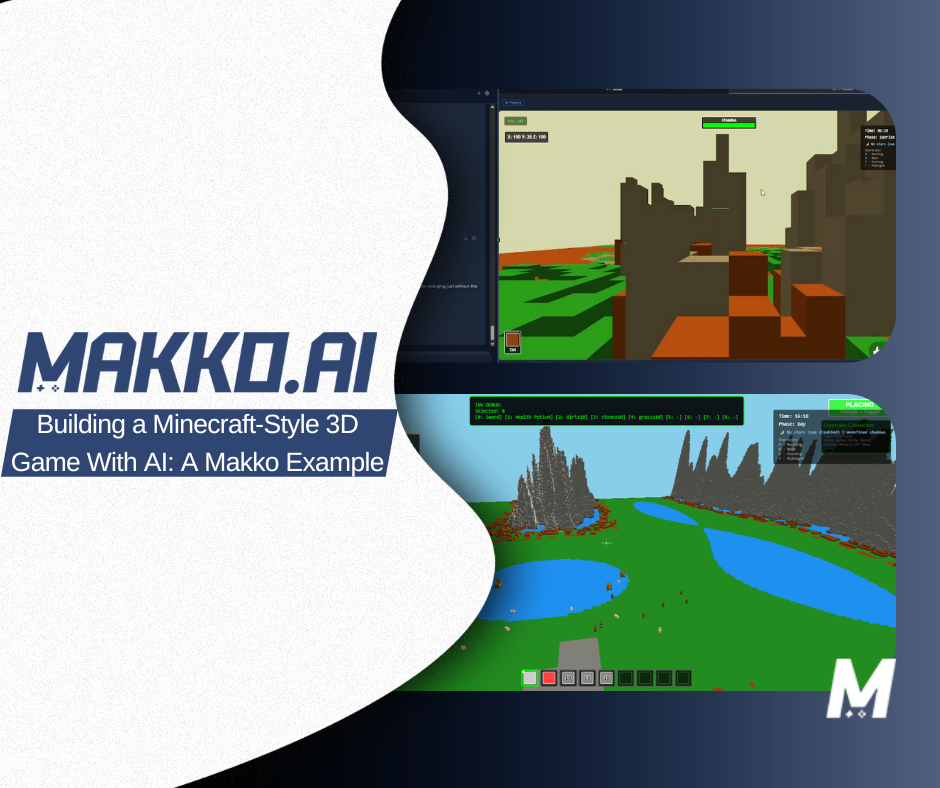
In 2026, that coordination does not have to be done manually. Creator ProPandaPlays built a Minecraft-style experience inside Makko's agentic AI environment: procedurally generated terrain, dynamic world streaming, multi-layered vertical depth, and interactive block placement, without manually scripting the underlying systems that make those features work together. For more real examples of games built this way, see what other creators have shipped.
This article breaks down what made that project technically interesting: what the hard problems in voxel-style development actually are, how an intent-driven workflow handles them differently from a traditional engine, and what the ProPandaPlays project demonstrates about where AI-native development can take a solo creator working on a system-heavy game.
Makko is a 2D-first platform. This case study is specifically about what its agent-based orchestration can do when pointed at 3D logic and block-based interaction through high-level prompts.
What Makes Voxel-Style Games Technically Challenging
Minecraft-style games introduce a complexity ceiling early in development because they require five interconnected systems to work simultaneously: procedural world generation, data persistence, verticality, mining mechanics, and performance scaling. None of these systems is particularly difficult in isolation. The problem is that they all need to talk to each other, and the failure mode for each one depends on whether the others are correctly maintaining their state. This is why the brick-by-brick approach to building game systems matters more here than in almost any other genre.
In a traditional engine, a creator must manually wire these systems together. That manual wiring is where state drift enters: the world fails to remember player changes because the persistence system was not updated when the terrain system changed how chunks are identified. The player sinks through the floor because the physics system was not informed that the ground layer was regenerated. These are not individual bugs. They are the consequence of systems that were never properly coordinated in the first place.
In an AI-native workflow, these systems are managed as a unified game state. Instead of writing individual rules for how deep a player can mine, the creator defines the behavior in natural language. The AI translates that intent into structured logic that handles collision and data storage, and maintains the relationship between them as the project evolves. The most common development bottleneck for voxel games — the conflict between high-speed movement and real-time terrain generation, becomes a system coordination problem that the AI manages rather than one the creator has to solve manually.
The Chunking and World Streaming Problem
Large block-based worlds rely on chunking: dividing space into manageable segments that can be loaded and unloaded independently based on player position. Without chunking, a large world would attempt to hold all of its data in memory simultaneously, which is not feasible at any meaningful world scale, particularly on web-based platforms where memory constraints are tighter than native applications.
In a traditional engine, chunking requires the creator to manually script the loading and unloading of each segment: defining the player's radius of influence, triggering asset retrieval when the player approaches a chunk boundary, and handling the edge cases where movement speed outpaces generation. Every one of these conditions is a failure point.
In Makko, describing the desired behavior, "generate new land as the player moves," is enough for the system to plan the relationship between player position and asset retrieval. The AI handles the background processing of chunks, coordinating loading and unloading without the creator needing to define each condition individually. The world feels continuous to the player even though only the immediately relevant segments are active at any moment. This is where Plan Mode earns its place, complex multi-system requests like this need the full planning layer before a single change is made.
The ProPandaPlays project demonstrates this working in practice: terrain that expands dynamically as the player moves, with no visible seams or performance degradation, built through high-level prompts rather than manual streaming logic.
Persistent World States: The Harder Problem
Persistence is what separates a terrain demo from a real Minecraft-style experience. If a player places or removes a block, that change must be recorded in the global state variables and correctly reapplied whenever that chunk is re-rendered. Without persistence, the player's changes disappear when they move away. The world resets to its generated state rather than the state they left it in.
Implementing persistence correctly requires a strict separation between world data and visual rendering. The data layer records what exists and where. The rendering layer reads from that data and draws accordingly. When a chunk is unloaded and reloaded, the rendering layer must pull from the data layer, not from a cached visual state. This architectural discipline is easy to describe and surprisingly difficult to maintain manually as a project grows in complexity.
In an AI-native workflow, the data structures for block storage can be generated from a description of the behavior rather than built from scratch. When the creator describes what persistence should accomplish, the AI builds the necessary architecture and maintains the relationship between the data layer and the rendering layer as new systems are added. The creator does not have to track every dependency manually. The AI holds that context across the project's development.
Any loss of saved player changes immediately breaks the immersion of a creative sandbox game. The persistence system is not optional, it is the feature that makes the world feel real. Getting it right matters more than almost any visual detail.
Advanced Techniques Used in This Project
The ProPandaPlays project uses three specific optimization techniques that are worth understanding because they appear in most voxel-style games and each one represents a system the AI had to coordinate correctly with the others.
- Chunk-based streaming, Limiting active world data to the player's immediate radius. Chunks outside this radius are unloaded; chunks the player approaches are generated or reloaded from the persistence layer.
- Greedy meshing — Reducing draw calls by combining adjacent block faces into single geometry where possible. This is a rendering optimization that has no effect on gameplay logic but is essential for keeping frame rate stable as world complexity increases.
- Back-face culling, Hiding geometry that is not visible to the camera. Underground block faces, interior wall surfaces, and any face not facing the viewport are excluded from rendering. This reduces the rendering load significantly in dense environments.
Each of these techniques touches a different layer of the system: data management, rendering, and visibility. Coordinating all three, making sure they do not contradict each other when the player moves, mines, or places blocks — is the kind of multi-system reasoning that agentic AI handles more reliably than manual scripting at this scale.
Why Intent-Driven Development Works for Complex Systems
The core advantage of an intent-driven workflow for voxel-style development is the shift from implementation-first to outcome-first thinking. Traditional tools like Unity require a creator to understand C# and the specific physics APIs before a single block can be placed and persist correctly. The implementation knowledge required to build the system is a prerequisite for designing the game.
In Makko's natural language environment, the creator can issue high-level prompts: "Add a difficulty curve that increases enemy spawn rates as the player digs deeper." The AI performs the multi-step reasoning required to link depth data to the spawn system, identify the state variables that need to connect them, and build the implementation in the right dependency order. The creator's job is to describe the desired outcome clearly. The AI's job is to figure out how to implement it consistently with everything that already exists in the project.
This workflow removes the implementation barrier that prevents many designers from building system-heavy games. It does not remove the design work — the creator still has to know what they want the game to do and describe it precisely. But it decouples that design knowledge from the engine knowledge that traditional development requires as a prerequisite.
While Makko remains optimized for 2D assets through Art Studio, this project confirms that the AI's ability to orchestrate complex system relationships extends to 3D logic and voxel simulations when the creator is willing to work within the prompting model.
What the ProPandaPlays Project Demonstrates
This project is a useful case study not because it represents a production-ready 3D engine replacement, but because it demonstrates the ceiling of what is possible when a solo creator uses agentic AI to coordinate system-heavy game logic.
Minecraft-style games are system-heavy experiences where complexity arises from scale and interaction rather than visual fidelity. The ProPandaPlays project covers the hardest parts of that complexity: terrain that generates and streams continuously, a world that remembers what the player did and where, and an optimization layer that keeps the experience playable on web platforms. These are not trivial problems. They are the problems that cause most voxel-style solo projects to stall before they are playable.
The project does not require Makko to be a 3D engine. It requires Makko to be good at coordinating systems. That is what the agentic AI model is specifically designed to do: maintain awareness of the full project state, plan changes in the correct dependency order, and keep systems consistent with each other as the project evolves.
For developers choosing between a traditional engine and an AI-native studio, the relevant question is not which tool has more features. It is which tool lets you reach a working, playable version of the game you actually want to make, as fast as possible. For a solo creator building a system-heavy world game, the answer that this project supports is the one that gets system coordination out of the way.
Watch the Project in Action
The video below shows the ProPandaPlays Minecraft-style project running inside Makko: procedural terrain generation, dynamic world streaming, block interaction, and multi-layer vertical depth, built through AI-orchestrated prompts rather than manual scripting.
Frequently Asked Questions
Can Makko build 3D games?
Makko is a 2D-first platform, but its agentic AI can orchestrate 3D logic and block-based interactions through high-level prompts. The ProPandaPlays project demonstrates a creator building procedurally generated terrain, world streaming, vertical depth, and interactive block placement inside Makko's AI-native environment. The 3D logic is coordinated by the AI rather than manually scripted by the creator.
What is chunking in voxel-style game development?
Chunking divides a large world into manageable segments that can be loaded and unloaded independently based on player position. Without chunking, a large block-based world would attempt to hold all of its data in memory at once, causing performance problems. In an AI-native workflow, the relationship between player position and chunk loading can be described in plain language and the AI handles the system coordination required to make it work.
What is world persistence in a Minecraft-style game?
World persistence means that changes a player makes to the world, placing or removing blocks, are recorded in global state variables and correctly reapplied whenever that area is rendered again. Without persistence, a player's changes disappear when they move away and return. It requires a strict separation of world data from visual rendering, and is one of the hardest systems to implement correctly in voxel-style games.
Why is intent-driven development faster for complex game systems?
Traditional engines require a creator to understand the specific APIs and scripting language before any system can be implemented. An intent-driven workflow lets the creator describe the desired behavior in plain language, and the AI performs the multi-step reasoning required to link systems together correctly. For system-heavy games like voxel builders, where five or more interdependent systems need to work together, the gap between description and working implementation that AI can bridge is particularly large.
For tutorials, walkthroughs, and live feature demos, visit the Makko YouTube channel.
Related Reading
- What Is Agentic AI in Game Development?
- How Agentic AI Chat Builds Game Logic
- AI Game Generator From Text: How to Build Games Using Natural Language
- State Awareness vs One-Shot Prompts: Why Your AI Game Logic Keeps Breaking
- How Agentic AI Automates Game Development
- Makko AI Game Development Glossary